Difference between revisions of "CEMS 2026"
| Line 44: | Line 44: | ||
|- | |- | ||
| <Time> || '''<name>''' ''(<school>)'': <TITLE> || <TIME>|| '''<NAME>''' ''(<SCHOOL>)'': <TITLE> | | <Time> || '''<name>''' ''(<school>)'': <TITLE> || <TIME>|| '''<NAME>''' ''(<SCHOOL>)'': <TITLE> | ||
| − | |||
|- | |- | ||
| || <div style="text-align: center;"> ''Spoken Session 2''|| || <div style="text-align: center;">''Spoken Session 2'' | | || <div style="text-align: center;"> ''Spoken Session 2''|| || <div style="text-align: center;">''Spoken Session 2'' | ||
Revision as of 20:11, 6 November 2025
CEMS 2026 is scheduled for Spring 2026. Stay tuned for details. THIS WEBSITE IS CURRENTLY INCOKPL

CEMS 2025 has been rescheduled from Spring/Summer 2025 to Late Fall/Winter 2025/2026. Stay tuned for details.
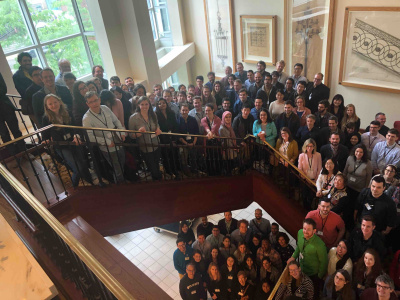
The 2024 Context and Episodic Memory Symposium (CEMS) took place at the Logan Hotel in Philadelphia, on May 30 and 31st, 2024.
Venue and Hotel Reservations
The venue for CEMS 2024 was The Logan Hotel, located in Philadelphia, Pennsylvania. Click here to view the location on Google Maps.
Schedule
To view the CEMS 2024 program pdf, click on this link.
| Thursday (5/30/24) | Friday (5/31/24) | ||||||||||
|---|---|---|---|---|---|---|---|---|---|---|---|
| Breakfast & Registration | |||||||||||
| <Time> | Welcome and Opening Remarks: <name> (<school>) | <TIME> | Breakfast | ||||||||
| <Spoken Session <x>>' |
<Spoken Session <x>>
| ||||||||||
| <Time> | <name> (<school>): <TITLE> | <TIME> | <NAME> (<SCHOOL>): <TITLE> | ||||||||
| Spoken Session 2 |
Spoken Session 2
| ||||||||||
| <TIME> | LUNCH | <TIME> | LUNCH | ||||||||
| <TIME> | Keynote Address: <NAME> (<SCHOOL>): <TITLE> | <TIME> | Poster Session 2 | ||||||||
| <TIME> | Data Blitz: | <TIME> | Data Blitz: | 1. <NAME> (<SCHOOL>), <TITLE> | 1. <NAME> (<SCHOOL>), <TITLE> | 5:00 | End | 5:00 | End | ||
Poster presenters
Poster details: boards, easels, and pins will be provided, size: 40"x60" (landscape).
| Poster session 1 | Poster session 2 |
|---|---|
| Aakash Sarkar (Boston University): Neurally inspired Deep networks with Laplace Neural Manifolds can show Temporal Receptive Windows | David Andrew Zarrin (NIH): The Effect of Real-time Ripple Oscillation Interference on Human Memory Retrieval |
| Abigail Mundorf (Michigan State University): Is organization decided at encoding? Effects of encoding and retrieval strategies. | Katherine Aboud (Vanderbilt University): The Role of Temporal and Semantic Factors in Encoding and Recall of Expository Text |
| Adam Osth (The University of Melbourne): A global similarity model of choice and response times of semantic and perceptual false memories in the Deese-Roediger-McDermott paradigm | Kelsey Sundby (NINDS): Testing the role of the subthalamic nucleus in memory-guided decisions |
| Aditya Rao (University of Pennsylvania): Synchronous theta networks characterize successful memory retrieval | Linda Hoffman (Temple University): Charting the Hippobellum: Dissection of Cerebellar-Hippocampal Connectivity |
| Ami Falk (University of Virginia): Detecting Heterogeneous Cognitive Strategies in Episodic Memory Tasks | Lucy Owen (Brown University): High-level cognition is supported by information-rich but compressible brain activity patterns |
| Anup Das (Columbia University): Planar, Spiral, and Concentric Traveling Waves Distinguish Cognitive States in Human Memory | Luke Pemberton (Boston University): Compressed conjunctive temporal representation of what and when in primary visual cortex |
| Augustin C. Hennings (Princeton University): Eye movements reveal the dynamics of memory reactivation supporting successful memory suppression | Lynn Lohnas (Syracuse University): Bridging retrieved context models across serial recall and free recall |
| Austin Greene (University of Virginia): A general and light spatial associative learning task for wide-scale application | Mason McClay (UCLA): Using a novel web app to examine dynamic emotional states and their relation to depression and trauma symptoms |
| Blake L. Elliott (Temple University): Hippocampal novelty signals dynamically predict goal relevant VTA activation. | Maya Geva-Sagiv (University of California, Davis, California): Hippocampal-prefrontal interactions underlying memory processes during goal-search in humans |
| Brian Winston (Johns Hopkins University): Effects of Psilocybin at Encoding on Recall of Naturalistic Stimuli | Md Rysul Kabir (Indiana University): Making Deep Neural Networks scale-invariant using cognitive models |
| Buddhika Bellana (York University, Glendon Campus): A distinctive role of deep processing on the persistence of recent experiences in spontaneous thought. | Michelle A. Dollois (University of Guelph): Modelling the underlying mechanisms of sequential dependencies in recognition memory |
| Charlotte Cornell (Rutgers University-New Brunswick): Improving Memory Search Through Model-Based Cue Selection | Muhammad Bilal Khan (University of Alberta): Judgements of spacing without reminding |
| Chenyu Wang (Boston University): Time cells for future actions in monkey PFC | Nathaniel R. Greene (University of Pennsylvania): New Perspectives on Age-Related Declines in Episodic Memory Specificity |
| Chong Zhao (University of Chicago): Attention Control Differences Predict Both Source and Recognition Memory Performance | Neal W Morton (University of Wisconsin–Milwaukee): Memory search dynamics reflect retrieval of semantic context |
| Christopher Hall (University of Virginia): Towards a Neurally Viable Computational Model of Continuous Recognition | Neomi Mizrachi (Weizmann Institute of Science): Gaze scan-paths are part of recall strategy in context dependent memory |
| Cody Dong (Princeton University): Strategic Control of Episodic Memory Retrieval During Story Reading | Nick Ichien (University of Pennsylvania): Relations in semantic memory search |
| Daniella Rafla (University of Pennsylvania): Organizational Dynamics of Memory Across Days | Nikolaus Salvatore (Rutgers University): Parallels between Neural Machine Translation and Human Memory Search: A Cognitive Modeling Approach |
| David F Gregory (Temple University): Arousal and neural circuity of temporal distance during horror movie watching. | Pierce C. Johnson (University at Albany, SUNY): Statistical Learning: The Formation of Musical Preferences |
| Devyn Smith (University of Virginia): Multivariate decoding of memory retrieval feedback signals | Rebecca Waugh (University of Virginia): Whole brain connectomics in episodic memory: neural correlates of the Continuous Associative Binding task |
| Elita Lee (Princeton University): Learning with caricatures facilitates discrimination of similar stimuli | Riley DeHaan (University of Pennsylvania): Predicting the Effects of Brain Stimulation from Observational Data |
| Geoffrey Ward (University of Essex): Effects of repetition, rehearsal, and a filled delay on free and serial recall. | Ryan A. Colyer, Jerome D. Hoover, and Alice F. Healy (University of Pennsylvania, University of Massachusetts Amherst, and University of Colorado Boulder): Large Language Model Simulation of Human Responses to Bat-and-Ball Problems |
| Haydn Herrema (University of Pennsylvania): Phonetic Features of Free Recall | Ryan Kirkpatrick (NIH/NINDS): Investigating the latent representations of encoded and retrieved memories in the anterior temporal lobe |
| Hemali Angne (Rutgers University-New Brunswick): Why Two Heads Together are Worse Than Apart: A Context-Based Account of Collaborative Inhibition in Memory Search | Sameer Sabharwal-Siddiqi (University of Arizona): Hippocampus is Important for Representational Precision of Public Event Memories Regardless of Their Age |
| James Mochizuki-Freeman (Indiana University Bloomington): Incorporating a cognitive model for evidence accumulation into deep reinforcement learning agents | Sean Polyn (Vanderbilt University): An instance-based retrieved-context theory of memory search in free recall |
| Jennifer Fiedler (UNC Chapel Hill): Repeating Contexts Enhances Episodic Memory Updating by Promoting Remindings and Integrative Encoding. | Soroush Mirjalili (University of Texas at Austin): More than sum of its parts: investigating episodic memory as a multidimensional cognitive process |
| Jiang Mao (University of Pennsylvania): The cost of stimulus encoding and maintenance in perceptual working memory | Tamara Gedankien (Columbia University): Cholinergic modulation of human hippocampal oscillations during encoding and retrieval |
| Jie Sun (The University of Melbourne): The Late Positive Event-Related Potential Component is Time-Locked to the Decision in Recognition Memory Tasks | Tankut Can (Institute for Advanced Study, Princeton University): Large-Scale Study of Human Memory for Narratives using Large Language Models |
| Jordan Gunn (Vanderbilt University): Some Problems for the Retrieved Context Account of Repetition and Spacing Effects | Taylor Chamberlain (Columbia University): Conjunctive encoding representations in expert and novice users of the Method of Loci mnemonic technique |
| Joseph Kahana (The Haverford School): Neural Decoding of Anticipation | Uma Mohan (NIH/NINDS): Modeling and predicting neural responses to multisite direct electrical brain stimulation in humans |
| Joseph Sommer (Rutgers University): Order-Constrained Models of Memory | Xinming Xu (Dartmouth College): Modeling the knowledge asymmetry of the past and the future |
Registration
Registration deadline: May 10th, 2024
Registration prices were as follow:
- $425 for non-faculty
- $500 for faculty
Conference registration included breakfast, lunch, and refreshments on all conference days.
Cancellations before May 1 were refunded, subject to a 10% cancellation fee. We apologize that we were not able to provide refunds after May 1.
Past Symposia
For information about past CEMS events, please click here.

